




For over two decades, Zanele Muholi has used photography as a tool for activism. At London’s QUEERCIRCLE, the renowned South African visual activist presents chapter nineteen of Faces and Phases, a long-running portrait project documenting Black queer existence across time and place, while reflecting on the personal and political forces that continue to shape their work.
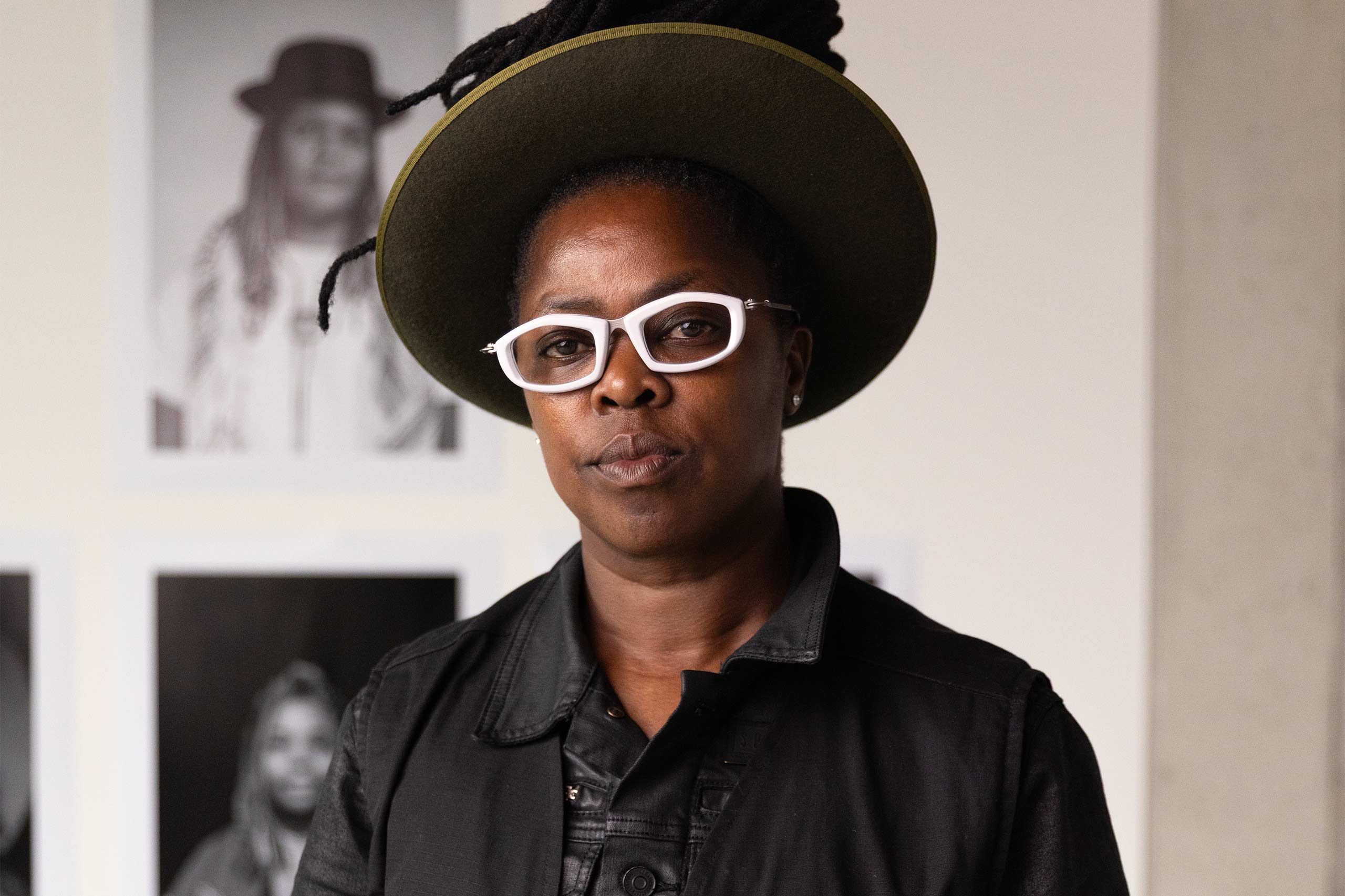
“Som-nya-ma”, Muholi breaks the word down into syllables. We repeat it back to them, and they nod in approval, continuing “Ngo-nya-ma”. The opening two letters – common in isiZulu but unfamiliar to English tongues – catch slightly in the mouth before settling into place: “Ngonyama… Somnyama Ngonyama”. Muholi smiles, their cheeks meeting the chunky white frame of their statement glasses. “Perfect!”
Translating to ‘Hail, the Dark Lioness’, those two rhythmic words form the title of one of the self-described visual activist’s most recognised and defining bodies of work: a long-running series of self-portraits that examine how Black identity has been represented, misunderstood, and distorted throughout photographic history. The images are mesmerising. In each stark, monochrome portrait, Muholi employs an evocative visual language, deepening the tonal contrast of their skin against the whites of their eyes in post-production to both celebrate Blackness and challenge colonial beauty standards that have long privileged lighter skin.
Muholi describes the series also as a way for them to confront their relationship with their own reflection. “I wanted to deal with all that made me feel uncomfortable. To deal with myself. To deal with my flaws. To look at myself as my body changed over a period of time”, they say, “I was once 20, then I woke up at 30, then I woke up at 40. That 20-year-old body is no longer the same”. Charismatic, with an unmistakable sense of style, one might find it hard to imagine that the artist would wrestle with their self-image, as so many of us do. “It’s the queerness of how your body changes with time”, they add, describing it almost like dysphoria in and of itself – an idea so clever it tickles the brain. “Literally, it’s the transitioning of the body”.
Behind Muholi’s crown of intertwining locks, another body of work tells a much different story. Still monochrome but more pared-back, the naturalistic portraits dotting the walls are not of Muholi at all, but of faces mostly unfamiliar to us: rows of queer individuals with different lived experiences and different stories written in their eyes. Here at London’s QUEERCIRCLE, a gallery and community space dedicated to LGBTQ+ art and culture, the South African artist exhibits chapter nineteen of their longest-running project to date, Faces and Phases.
They launched the series in 2006 after studying photography at Market Photo Workshop (conceived by David Goldblatt) in Johannesburg, during a period of deep involvement in LGBTQ+ activism, including co-founding the Forum for the Empowerment of Women (FEW). Emerging from a need to create visibility and a historical record for communities who were – and still are – marginalised, subjected to systemic violence, and erased in mainstream visual culture, the project centres candid portraits of Black lesbian, trans, and gender-nonconforming people in South Africa and the wider diaspora.
The message behind Faces and Phases feels inseparable from the artist’s own upbringing. Born in Umlazi, Durban, and raised during the height of apartheid, Zanele Muholi grew up in a society where Black lives and identities were severely repressed. Even sexuality was subject to apartheid’s machinery of control. The Immorality Act of 1957, for example, criminalised interracial relationships and homosexuality, reinforcing the regime’s broader project of regulating bodies and identity. This project has become, in part, a response to that history: an ever-expanding archive built to ensure queer Black lives are seen and remembered. And seen they have been. Over the past two decades, the series has travelled far beyond South Africa, reaching museums across continents, including the Brooklyn Museum in New York, Tate Modern in London, the 55th Venice Biennale, and the 29th São Paulo Biennale, accumulating faces along the way.
“I’m pushing a political agenda”, Muholi proudly states. “It’s one thing for us to be at Pride, but it’s something else for us to be in spaces like this where you see likeness, where you see yourself without fear or shame, where you see your neighbour, your lover, your friend’s lover, your colleague, your classmate – where nobody judges anybody”. We don’t spot any of our lovers (or ex-lovers, thankfully), but on closer inspection, there are one or two faces we’ve seen before in some of London’s Black-centred spaces, including that of Aisha Shaibu-Lenoir, the co-founder and director of the independent queer-intersectional bookshop and community space The Common Press. She works closely with Muholi to help them find their subjects.
Asked what they look for in participants (we’re not subtly volunteering), Muholi says there are no real criteria beyond being of legal age and out of the closet, for your own safety. Beyond that, it’s simply a matter of who catches their eye.
Muholi’s mission to uplift and empower Black queer lives does not begin and end with exhibitions like the one at QUEERCIRCLE. Now primarily based in electric Joburg, they continue to train and co-facilitate photography workshops for young queer people living in townships, encouraging them to document their own lives and communities, and carve out their own space in the art world. The work is especially urgent in a context where homophobia across parts of the continent is still justified by the persistent myth that homosexuality is somehow “un-African”. History, of course, tells a different story, with many scholars pointing to colonial-era laws as the roots of much of the criminalisation and stigma that exist today.
As Muholi notes, South Africa remains the most progressive country on the continent when it comes to LGBTQ+ rights, with strong constitutional protections against discrimination and, since 2006, the distinction of being the first – and still the only – African country to legalise same-sex marriage. The country’s legislative capital, Cape Town, is one of the clearest examples of this openness, particularly in neighbourhoods like De Waterkant, where a cluster of cafés, bars, and guesthouses has long catered to the queer community.
Change can be slow, but with activists like Zanele Muholi leading the charge, we have reason to feel optimistic.
www.queercircle.org | www.commonpress.co.uk
Photography and video by Martin Perry and Bradley Burke