
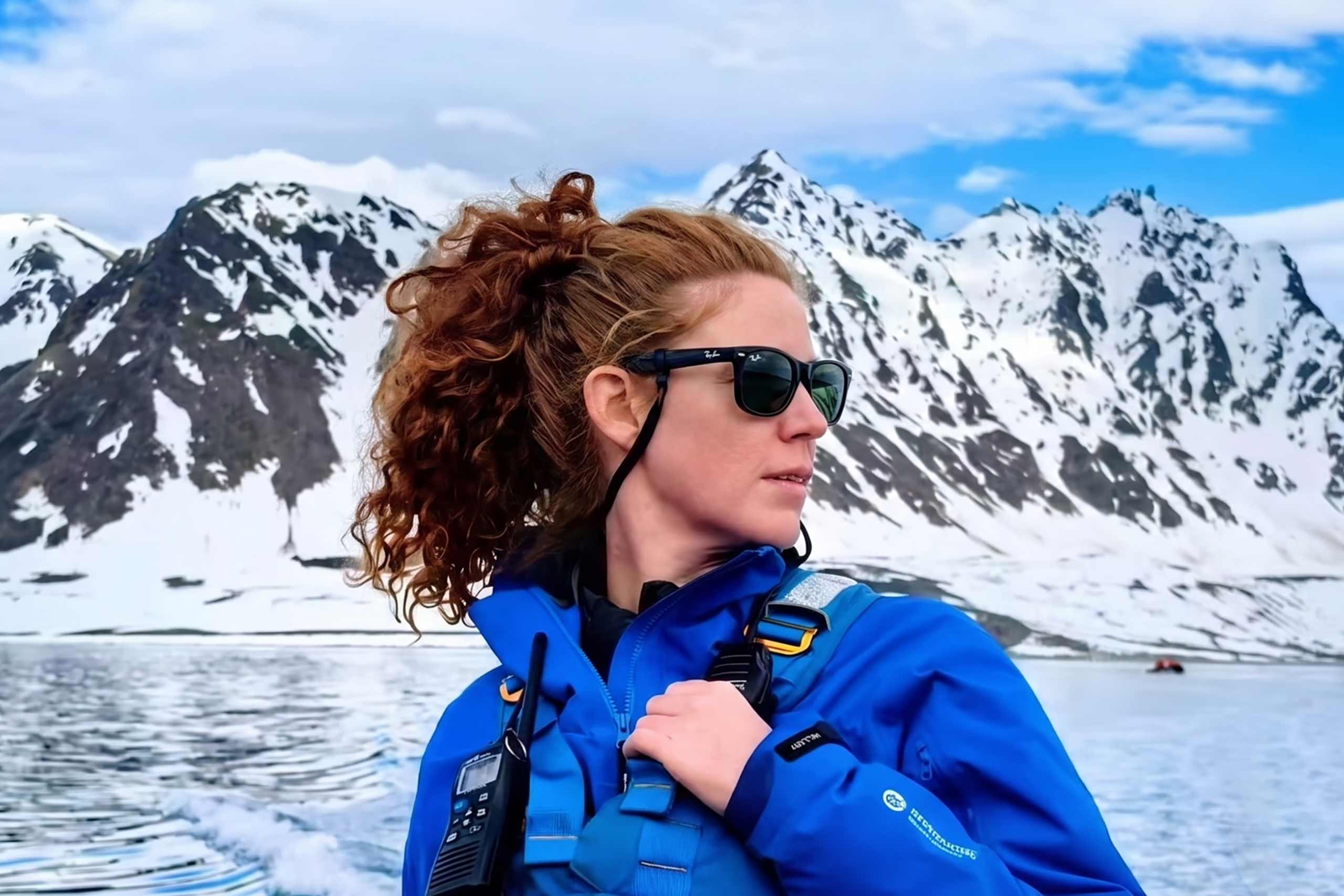



In a world that constantly asks us to edit ourselves, to soften our edges or to make ourselves more legible, the Arctic does the opposite: it removes the noise entirely. It is here, in this vast and uncompromising landscape, that Sarah Schwimmer has honed a philosophy that challenges not only how we travel, but how we understand belonging, fear, freedom and resilience. Naturalist, ecologist and expedition leader, Schwimmer has guided travellers through some of the planet’s most extreme environments, yet her most compelling journey is the one she takes inward – and invites others to take with her. In this deeply personal conversation, she speaks about queerness, courage, grief and joy, and the radical clarity of the wild, revealing why she wants to share the Arctic with other queer women as “a mirror for everything we carry within us”.
Some places demand you become smaller. The Arctic is one of them. Stand beneath a glacier, and every carefully constructed version of yourself will begin to dissolve into silence. The wind edits your thoughts. The ice ignores your ambitions. The horizon stretches beyond certainty until all that’s left is curiosity.
But perhaps that’s only half the story. Because for Sarah Schwimmer, the Arctic does not diminish identity – it clarifies it. Sarah is one of the most recognisable LGBTQ+ voices in modern adventure travel, having spent her life moving through some of Earth’s most extreme and revealing landscapes: the fjords of Patagonia, the frozen edges of Antarctica, the shifting silence of the High Arctic. Yet her story is not simply one of distance travelled, but of depth reached.
What emerges in our conversation is someone who has repeatedly chosen to walk towards the very things she was once taught to avoid. She frames fear as “an invitation”. She finds refuge in landscapes that offer something society does not: impartiality. In the wild, she discovered not escape, but equality.
That sense of belonging has since become the backbone of her work. Whether guiding expeditions or holding space for LGBTQ+ travellers in remote environments, Sarah Schwimmer speaks not about wilderness as backdrop, but as teacher.
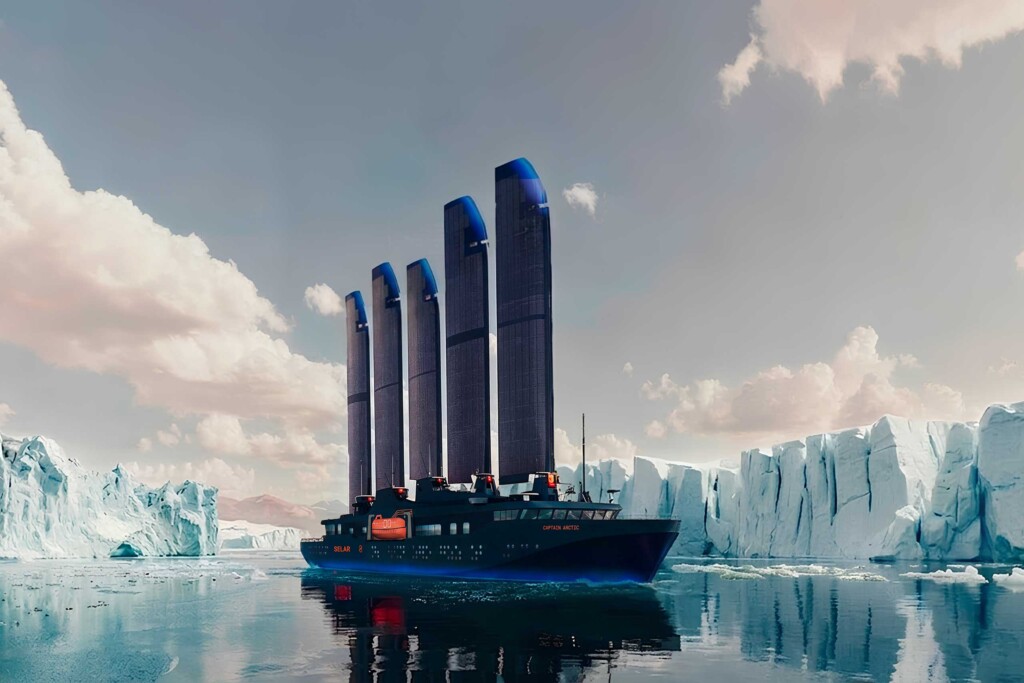
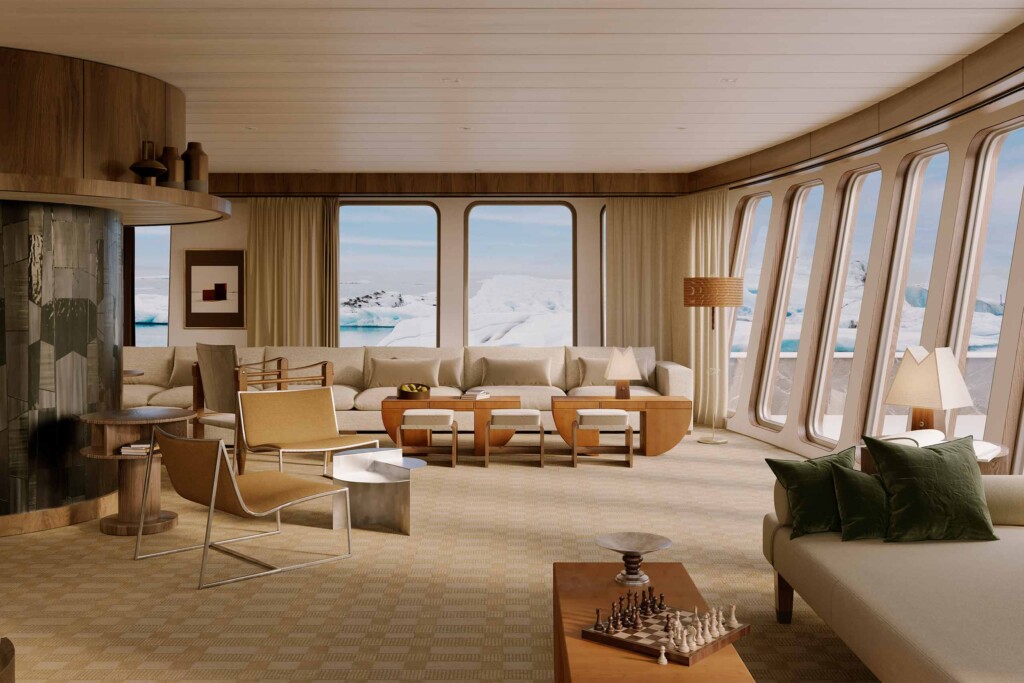
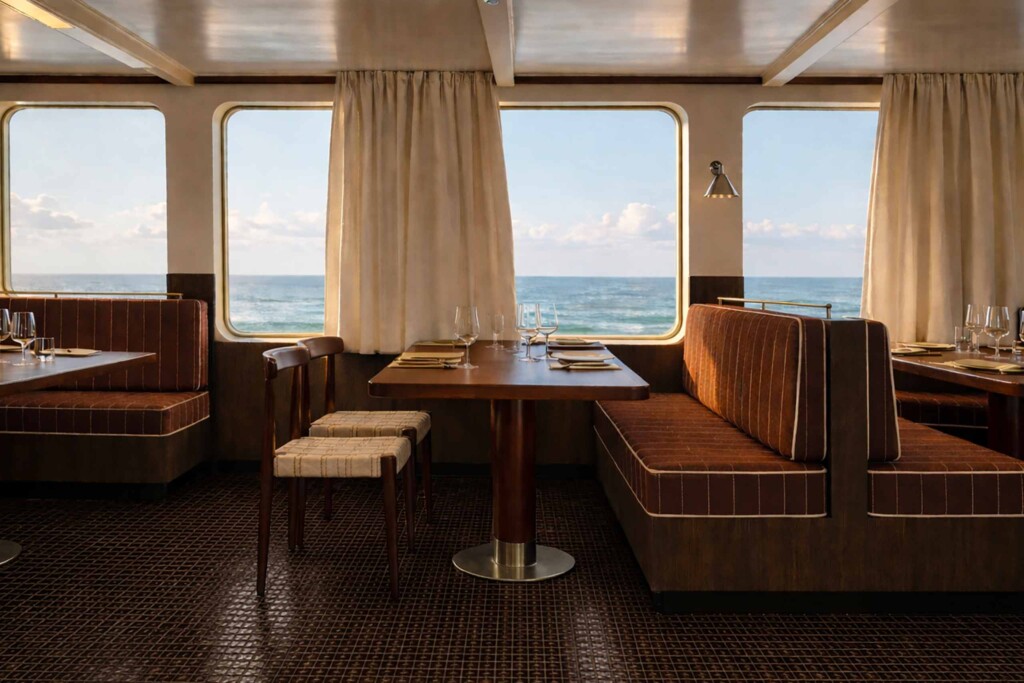
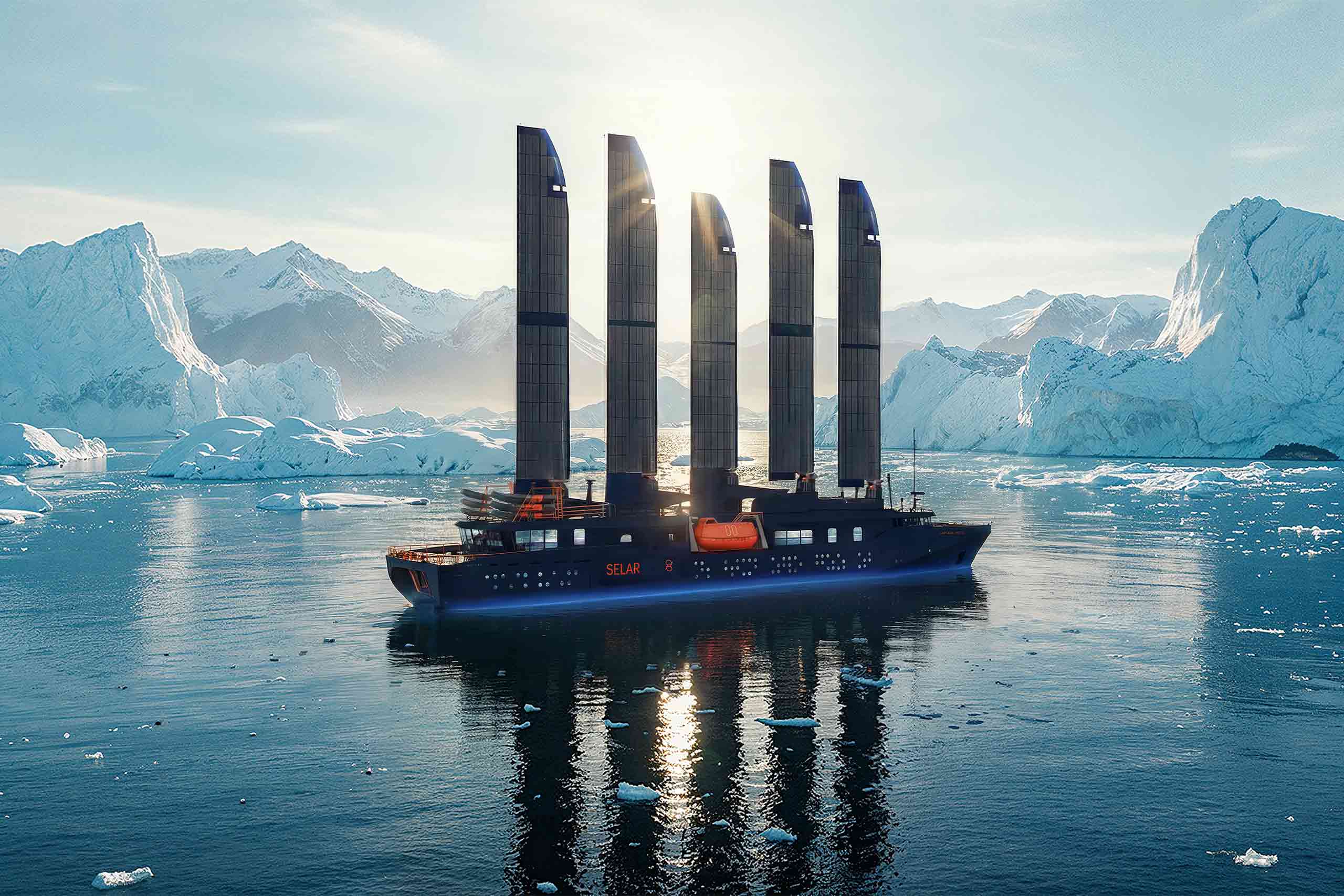
It is perhaps no surprise, then, that her next chapter is not just a continuation of her work, but a deliberate reimagining of it. Sarah Schwimmer has joined forces with the world’s first, queer, female Arctic captain, Sophie Galvagnon – to create a new Arctic expedition for queer women on Sophie’s landmark, solar-powered Arctic expedition yacht Captain Arctic, by Selar. Built on the foundations of sustainability, accessibility and lived experience, the journey is designed not as escape, but as arrival: into landscape, into community, and into oneself.
What’s the story behind your journey so far?
My journey has been a series of instinctive decisions. I can’t claim I ever had a master plan, because I didn’t see anyone doing exactly what I wanted. My own path has been about trusting that my curiosity is worth following, that it’s leading me somewhere worthwhile, and that I am capable of figuring everything out as I go.
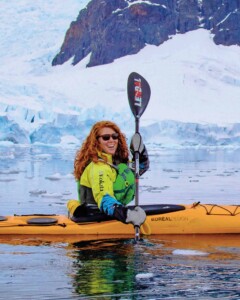
What rarely makes it into interviews is my relationship with fear. People assume you must be fearless to have adventures like these. That is absolutely untrue. Growing up, I was petrified of dogs, thunderstorms, heights, deep water, fish, spiders… the list was long. I had to decide that I’m writing my own story and I don’t want it to be about everything I avoided, so I learned to be afraid and do it anyway. That lesson has been foundational. Especially as a queer person, so much of our lives requires us to do things while afraid: coming out. Holding hands in public. Being visible and vocal. Advocating for our rights.
At some point, I made a decision to see fear as an invitation. I sailed professionally on tall ships and climbed into the rigging to overcome my fear of heights. To overcome my fear of deep water and the life within it, I became an advanced scuba diver. And there are many more examples. Seeing fear as an invitation to explore has shaped my life just as much as following my curiosity, with the added benefit of making me feel more capable and resilient.
You explore some of the most remote places on Earth. What draws you to these environments?
Growing up, I was bullied for my severe dyslexia, my red hair, my family’s income and our multicultural background. Secretly being gay made all of that even more isolating.
Some of my early happy memories are lying on the floor with National Geographic magazines spread out around me, completely absorbed.
What I sensed, even as a kid in a big city, was that nature didn’t care about any of it. The animals, the mountains, the ocean, they treat you the same regardless of who you are. Nature was the first place I felt genuinely safe and free.
Beyond safety, I view nature as sacred. It’s where I feel most connected to life itself. Where human-made distractions fall away, and what remains is real.
How has your experience of being part of the LGBTQ+ community shaped the way you travel?
I adjust my behaviour out of respect for local cultures and for my own safety, but the core of who I am is the common thread across every country I’ve ever entered. I don’t leave parts of myself at the border.
Travel has given me an ever-deepening sense of what my freedom means and what it costs those who don’t have it. Travelling to countries with limited LGBTQ+ rights has been surprisingly healing. I’m writing this from Japan, which has a vibrant queer culture, yet its fight for marriage equality persists. When we travel, we can connect with people, and we can give each other hope.
The privilege to be a gay woman who can travel the world is both a joy and a responsibility. I’m extraordinarily fortunate to live the life I live. The question I carry with me everywhere is: how do I use this freedom intentionally? Who do I want writing my story – me, a lesbian living openly, or governments that have decided what we are and aren’t allowed to be?
Giving back is part of how I answer that. Through my work in the travel industry, I’ve fundraised for Hope for Girls and Women Tanzania, helped plant trees through a women-run reforestation project in Nepal, and volunteered remotely on LGBTQ+ scholarship committees so I could contribute even from afar. Activism, for me, isn’t separate from travel; it’s woven through it.
Why do you think it’s important for LGBTQ+ people to engage with the wider world? How do you balance getting out into it with real considerations of safety and belonging?
I used to feel conflicted about travelling to countries where LGBTQ+ people have no legal protection. Now, I’ve come to believe it matters deeply.
While in a country where LGBTQ+ relationships are criminalised, a worker once approached me quietly after overhearing me mention my wife. She wept when she learned I was happily married to a woman. She’d heard it was possible, but she didn’t know if it was real. She decided to find a way to immigrate to a new country, so she and her partner could be together openly.
In another country, I met a woman whose uncle had been executed after being caught on Grindr. She had never been able to speak about her grief openly. She told me, with tremendous pride, that she believed gay people deserve safety and that this was one of her most sincere hopes for her country’s future. She thanked us for coming, and she made sure my group felt safe and welcome throughout our trip.
In the Dominican Republic, locals told me that they had believed being gay meant being evil. After spending a week with my group, they said they couldn’t believe that anymore.
I have so many stories like these. And they matter; they have a ripple effect far beyond what we see.
In wilderness specifically, our presence challenges the story of who these places are for. Being a visibly queer woman serving as a polar bear guard in the High Arctic, leading kayaking in Antarctica, and guiding people through the Alaskan backcountry are all quiet acts of defiance against the status quo.
Nature is for everyone. The sooner that’s reflected in who shows up and who leads, the better.
The Arctic is often described as empty, yet you speak of it as alive. What do you see there that others might miss?
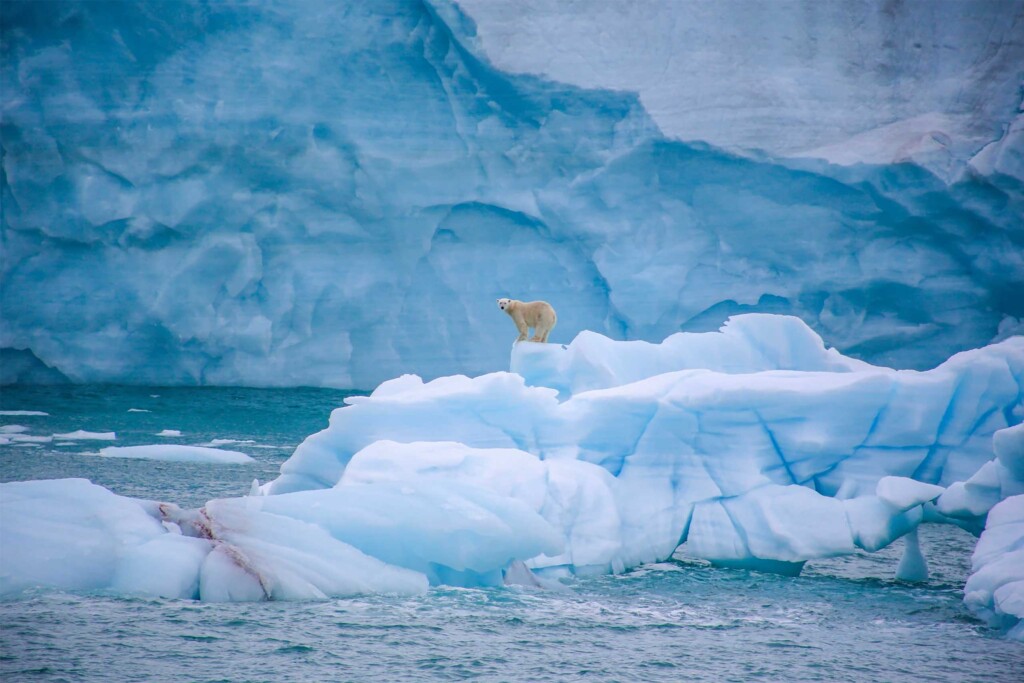
The Arctic is anything but empty. The process of learning to see that is itself transformative.
Stand before a glacier and your first impression may be of emptiness: the ice has pulverised and bulldozed everything. But look closely at what appears to be bare rock, and you’ll find pioneer lichens slowly, patiently releasing minerals from the stone itself, building the first thin layer of soil that makes all future life possible. You’ll find birds’ eggs nestled between stones. Sit still and arctic foxes appear. Listen – hear that wilderness is not silent: there is a symphony of glacial ice, water, and wind, punctuated by the occasional exhales of surfacing whales.
The Arctic reminds me that life is both fragile and powerful. That loss is inevitable, but so is life. Every ending already contains its beginning.
I think about this often as a queer person. Every loss our community has endured has also laid groundwork for something new. We are like those pioneering lichens: we take whatever life gives us and alchemise it into something that makes life possible for everyone who comes after. We build the conditions for others to flourish. We make the world more colourful simply by being here.
These are things the wilderness teaches, not as metaphors, but as lived facts. We are part of this cycle. We are not separate from it. That knowledge doesn’t leave you.
‘Pride’, diversity, and inclusion are often associated with cities – parades, nightlife, visibility. What does Pride look and feel like in the wilderness?
I grew up in a city but left, closeted, before I turned 18. I didn’t experience Pride parades or queer community until my 30s, because I spent most of my 20s in the wilderness in Patagonia, Antarctica, and the Arctic. Then in my 30s I went all-in on queer culture: the Dinah Shore, Denver Pride, gay bars, lesbian group travel. I finally experienced what “community” and “chosen family” meant, and why those are such essential aspects of our experience.
Leading LGBTQ+ expeditions changed what I understand leadership to be. In those groups, people are connected at a level that rarely exists in mixed groups. It transforms the experience for everyone. The pride is explicit rather than implicit. And the level of genuine supportiveness is unmatched in those groups.
That level of connection created space for me to develop further my style of leadership: built on compassion, on treating each person’s unique identity as valuable, on giving people genuine safety to be fully seen.
I bring that approach into every expedition I lead now, regardless of who’s with me. It may land differently with heterosexual male audiences, but it still lands powerfully.
After many experiences where I felt unsafe and unwelcome as a queer woman in the outdoor industry, last year I made a decision: I would not return to Svalbard until I could do it in a way that aligned with my values. And I realised I’d have to build it myself.
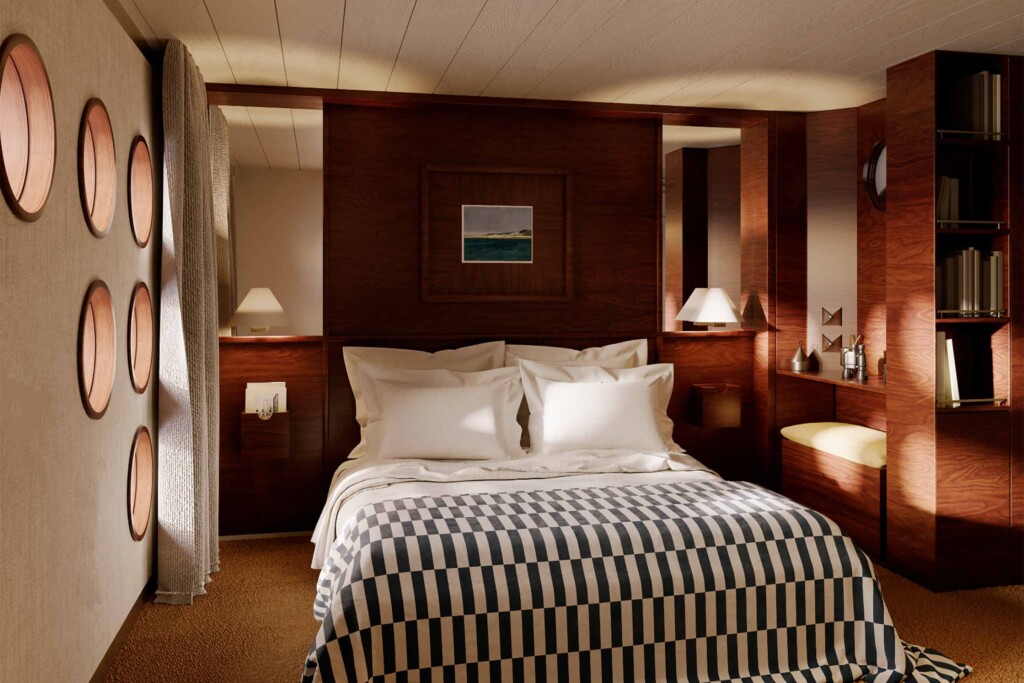
I selected the solar-powered sailing vessel Captain Arctic entirely for its commitment to sustainability before I knew anything else about it. Only after I chose it did I learn about Captain Sophie Galvagnon’s own remarkable story. The expedition grew from there. The response so far has been extraordinary, from queer travellers, but also straight travellers hungry for something more thoughtful and connected. And I’ve been moved by messages from people who use wheelchairs, who said they felt safe to reach out based on the message of inclusion. Captain Arctic has a wheelchair-accessible cabin, because the goal truly is inclusivity.
That is what this expedition is: a demonstration of what Arctic travel becomes when it’s guided by queerness, by a feminine perspective, by genuine care for people and the environments we explore. The world hasn’t seen enough of LGBTQ+ folks and women in wilderness expeditions. It’s time to change that.
The climate crisis is especially visible in polar regions. In the face of that, does hope still exist for you out there? What do you hope people carry home?
I fell in love with glaciers in Patagonia in my mid-twenties and have been drawn to them ever since. You get to know them like familiar friends. And then you watch them thin and recede, year by year, and it weighs on you. It’s like the burning of the Library of Alexandria: we are losing knowledge we don’t even fully know how to read, something whose full importance we can’t yet comprehend.
My background is in ecology, so what I’m trained to see, and what I love to share, is systems and interconnectedness. The unseen threads that hold everything together. Teaching people to list every species we encounter matters less to me than showing them how every element of an ecosystem is interconnected and helping them feel that they are fully part of that world. That they are not separate from nature’s stories; what happens to nature happens to all of us.
That’s what I want people to carry home. Awe, and an unshakable awareness that we are woven into something larger than ourselves. That deep knowing changes how people move through the world, which gives me hope.
What have the extremes – the poles, the silence, the isolation – taught you about life that nothing else could?
I was never out there trying to find myself. But I did want to know who I am outside of everything familiar. Without structure, social roles, safety nets… in the literal unknown.
The wilderness distils everything down to necessity. Life in its most essential form. Out there, you can press your fingers against the pulse of life itself: feel it, listen to it, breathe it in. And in that, I find I can attune to myself. Not a constructed version of myself. Just Sarah Schwimmer.
What I’ve discovered is that I am someone who feels, thinks and experiences deeply; that I feel most alive when I’m most present; that I have taught myself to stay grounded and clear-headed when circumstances are beyond my control.
People use wilderness as a metaphor for all of this constantly. Leadership books are full of it. What I get to do is live it: to literally navigate uncharted waters and go beyond the edges of the map. And what I’ve found there has given me more than any metaphor could.
The average person will never face a polar bear. But they will encounter the uncontrollable. They will face the unknown. The wilderness shows us that we are more capable of meeting those moments than we believe.
Is there anything you wish people would ask you more often?
I wish people asked what it actually costs to do this work as a queer woman in a field that wasn’t built for us.
In this industry, I regularly encounter being dismissed and talked over, my authority undermined, and my safety treated as secondary. It’s exhausting to navigate. It’s rarely spoken about because the industry wants us to keep showing up with a smile. We need to have more conversations about how to support minorities within the outdoor industry in order for things to get better.
But I also wish people asked more about the joy. Because there is extraordinary, transformative, healing joy in this work. That is what I do it for. That is what I’m bringing people to Svalbard to find.
I have only sailed with a handful of female captains throughout 18+ years working on the water… and none of them has been a fellow queer woman. The fact that this ship was designed by Captain Sophie, and the level at which her perspective will also shape this experience, is truly unlike anything I’ve been able to do before.
So if you’ve been waiting for an Arctic expedition that doesn’t ask you to check any part of yourself at the gangway, I hope to see you in Svalbard. Guided by queer leadership, deep ecological knowledge, and a genuine commitment to leaving it better than we found it.
Photography courtesy of Selar
OutThere recommends
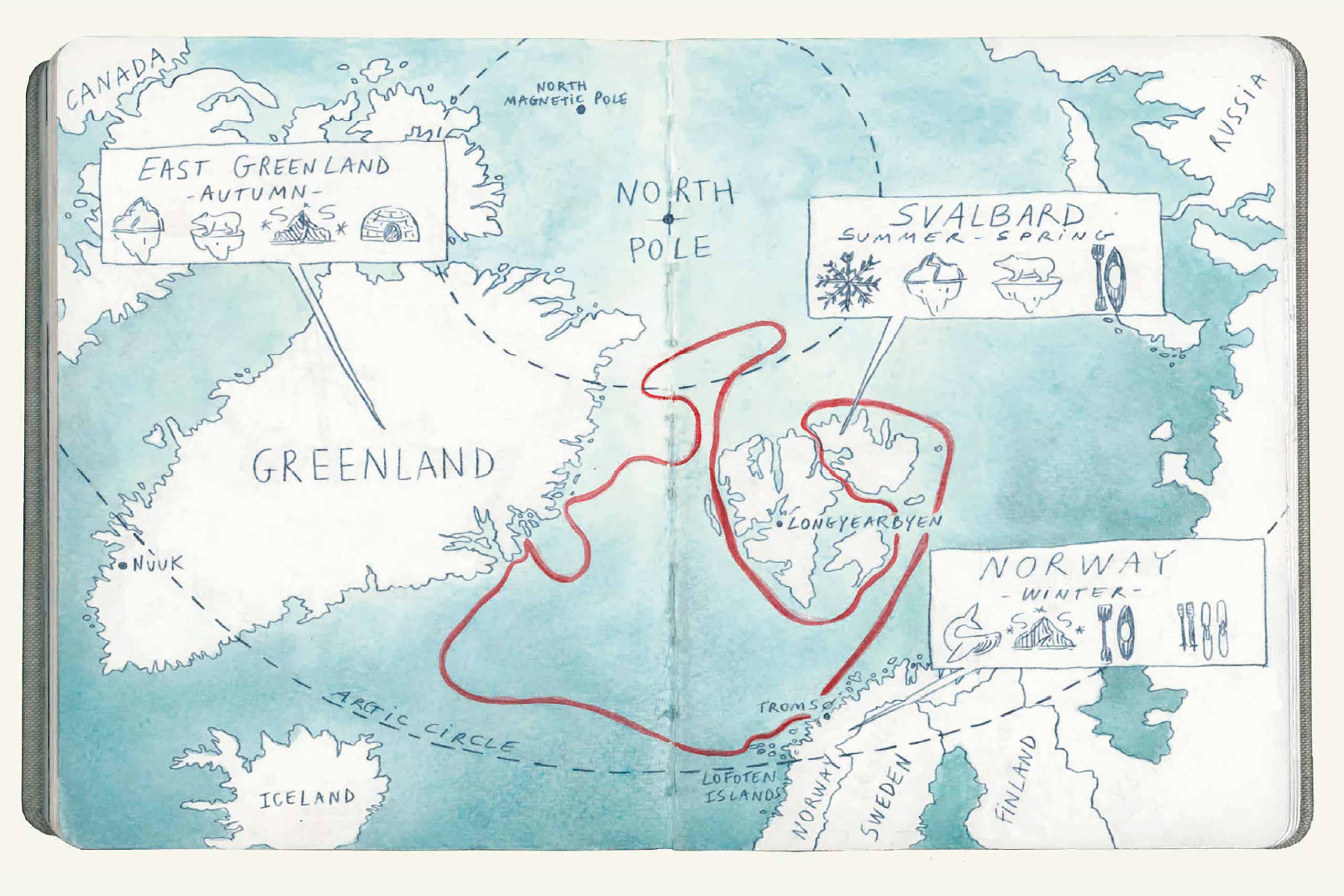
In the summer of 2027 (28th July – 08th August), Sarah Schwimmer joins polar sailing company Selar as a special guest aboard Svalbard in the Midnight Sun, an intimate 12-day expedition through the Norwegian Arctic.
Designed around exploration rather than fixed itineraries, the voyage combines glacier hikes, kayaking, wildlife encounters and evenings spent swapping stories beneath a sun that never sets. With just 36 guests aboard a low-impact solar sailing vessel and a strong emphasis on community, curiosity and conservation, the experience promises a different kind of luxury: time, silence and genuine human connection.
For LGBTQ+ women and their friends seeking adventure beyond the expected, this journey may prove that the greatest discoveries are not always found on the map.
GBP£17,625 / EURO€20,350 / USD$23,325
Book now, or enquire at [email protected]
*currency fluctuations apply
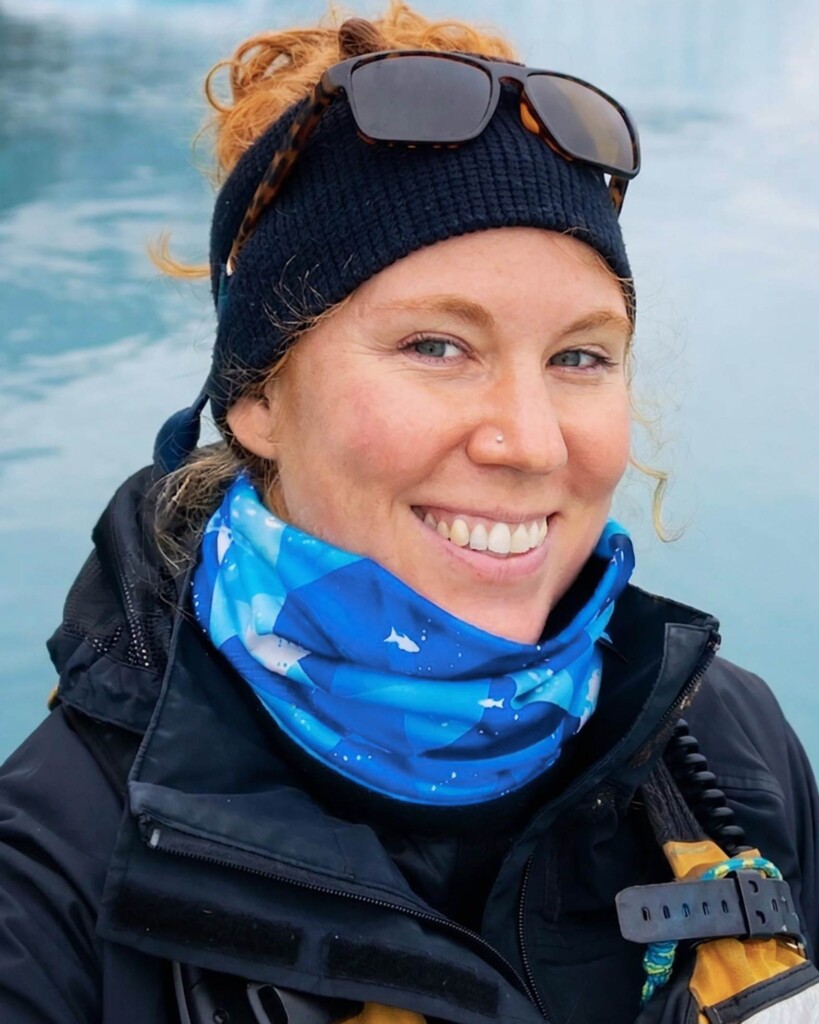
“I often think that knowing where you do not belong can be one of life’s greatest gifts. My journey began on a small plastic sailboat on an inland lake, but what propelled me forward was a restlessness and a sense that I was searching for somewhere I could fully be myself. That search took me to the fjords of Patagonia, on more voyages to Antarctica than I can count, and deep into the High Arctic, leading expeditions in some of the wildest places on Earth. Looking back, much of that feeling of not quite belonging was tied to my queerness. Coming out as a lesbian opened an entirely new chapter, filled with community, purpose and connection. As an ecologist and naturalist, I see the Arctic as a living, breathing system – ancient, fragile and endlessly wondrous. I have found that adventure is most powerful when shared with people who truly see you. There is a special kind of magic in standing in the wilderness alongside your community”
– Sarah Schwimmer, The Vagabondist
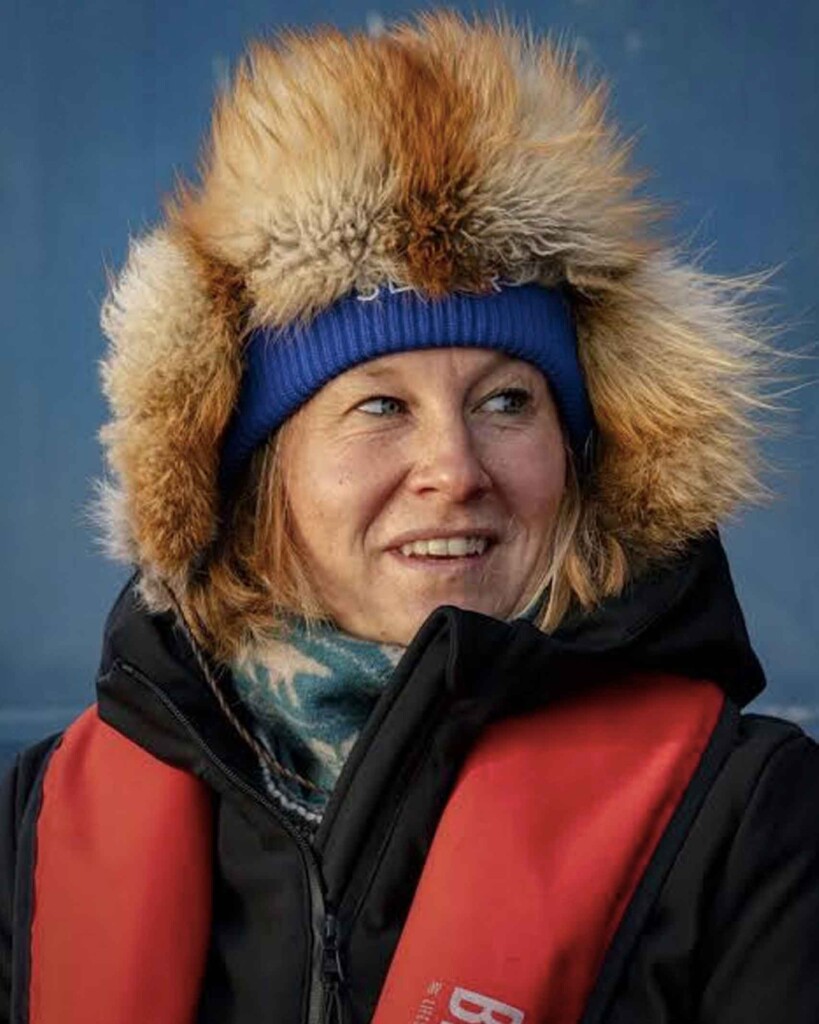
“I’ve been sailing in the Arctic for over a decade and, despite the privilege of working aboard some incredible expedition ships, I always felt something was missing. When it was just the crew, we could venture off the beaten path and embrace the unexpected. But with guests on board, we often followed fixed itineraries, leaving little room for the spontaneity and discovery that make travel so transformative. So I began imagining something different: a smaller sailing vessel, free to follow the weather, wildlife and wonder of the moment. The Arctic is also where I came out. In one of the most remote places on Earth, I made the decision to live openly and authentically. I believe ships, like any workplace, should be spaces of respect, inclusion and belonging, and I am committed to helping our community feel visible and welcome at sea. Hosting this LGBTQIA+ voyage is a dream come true. I cannot wait to share this extraordinary human adventure with you”
– Sophie Galvagnon, Captain & CEO, Selar